
REVIEW · ASWAN
3-Nights Cruise From Aswan,Aswan and Luxor Temples & Tours With Balloon
Ancient Egypt unfolds one river stop at a time. This four-day, three-night cruise from Aswan to Luxor combines major temples, a long visit to Abu Simbel, onboard meals, and a sunrise hot-air balloon ride over Luxor’s West Bank. I especially like the route’s steady rhythm: sail, explore, eat, then move on to another major site without changing hotels every night.
I also like the personal setup. Pickup is available from an Aswan hotel, airport, or train station, and the trip ends with drop-off in Luxor. Guides such as Mohamed and Laila have earned strong praise for clear explanations and warm service. The main drawback is the price structure: the $660 fare includes many services, but entrance fees are not included, so your final cost will be higher.
The details that shape the trip
- Four days and three nights aboard a 5-star Nile cruise, traveling from Aswan to Luxor.
- Abu Simbel is included, with about seven hours set aside for the journey and visit.
- Philae, Kom Ombo, Edfu, Luxor, Karnak, Hatshepsut, and the Valley of the Kings fill the route with major sights.
- A sunrise hot-air balloon flight over Luxor gives you a rare view of the West Bank monuments.
- Meals are built into the schedule, including four lunches, three dinners, and three breakfasts.
- Private touring is provided for your group, with an Egyptology guide, air-conditioned transport, boat transfers, horse and carriage, and Wi-Fi up to 4 GB.
What $660 really covers
At $660 per person, this is not a simple cruise-only deal. You are paying for three nights aboard a 5-star vessel, transportation, a private guide, meals, the balloon flight, and a full sequence of major archaeological sites.
That package has real value if you want your Upper Egypt logistics handled in one booking. Pickup, transfers, meals, sightseeing, and the river journey are joined together. You do not need to arrange separate transport from Aswan to each temple, then find a new hotel in Luxor.
Still, keep your budget realistic. The entrance fees for the listed sites are excluded. That matters because this route includes several of Egypt’s most important paid attractions, including Philae, Abu Simbel, Kom Ombo, Edfu, Luxor Temple, the Valley of the Kings, Hatshepsut, and Karnak.
The tour includes all mentioned sites in the program, but the wording also says admission tickets are not included. I would ask for the current entrance-fee total before paying. That one question will give you a clearer picture of the final price.
The cruise also includes four lunches, three dinners, and three breakfasts. The stated meal schedule begins with lunch and ends with breakfast on the final day. That is useful on a tightly planned route, since you will spend long stretches away from the ship.
A few more balloon flights around Aswan worth a look
- 4-Days Nile Cruise From Aswan To Luxor including Abu Simbel and Hot Air Balloon
★ 5.0 · 3,142 reviews - 4-Day 3-Night Nile Cruise from Aswan to Luxor&Abu Simbel+Balloon
★ 5.0 · 2,023 reviews - 4-Day 3-Night Nile Cruise from Aswan to Luxor including Abu Simbel, Air Balloon
★ 4.5 · 612 reviews
Day one: Philae and the engineering of the High Dam
Pickup can take place at your Aswan hotel, Aswan Airport, or Aswan Train Station. That makes the opening day practical if you arrive by air or rail, rather than spending part of the morning finding your way to the boat.
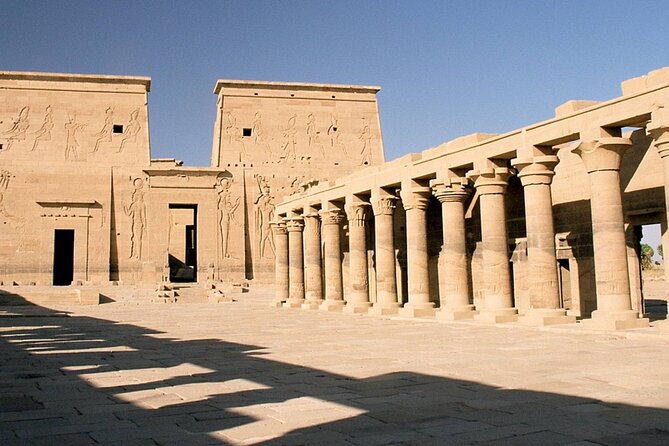
The first major stop is Philae Temple, reached by motor boat because the temple complex sits on an island in the Nile. The site is closely linked to the worship of Isis, and other structures on the island were dedicated to deities including Hathor and Amenhotep.
The boat ride adds something important. Philae is not simply a temple beside a road. You approach it across the water, with the island setting helping you understand why the site feels separate from modern Aswan.
The program allows about two hours here. That is enough for a guided look at the principal structures, though you will want to stay close to your guide because the complex contains plenty of carved details and religious symbols.
The next stop is the Aswan High Dam, also scheduled for about two hours. Built during the rule of Gamal Abdel Nasser with Soviet assistance, the dam changed the flow and control of the Nile and helped generate electricity for Egypt.
This visit provides useful modern context. Ancient Egypt depended on the river’s yearly cycle, while modern Egypt sought to control that cycle on a national scale. The dam is not as visually delicate as Philae, but it helps explain why several ancient monuments had to be protected and moved.
Admission is not included at these stops. After the visits, you settle into the cruise for the first night. Since the trip is private for your group, you should have a better chance to ask questions and set the pace than on a large shared coach tour.
Day two: Abu Simbel and the temple of two gods
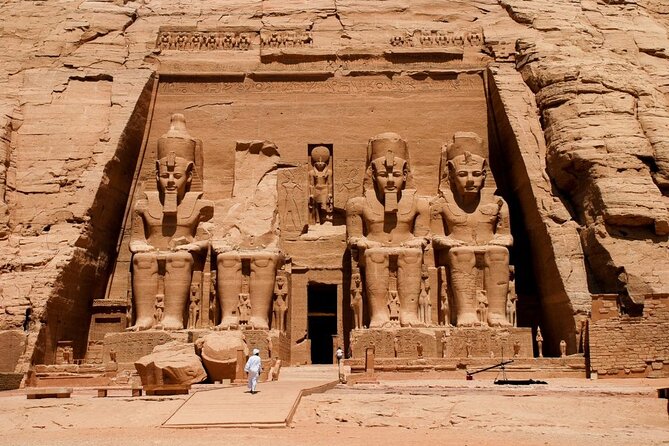
The Abu Simbel excursion is the longest single visit on the schedule, at about seven hours. The complex lies roughly 285 to 290 kilometers south of Aswan, on the west bank of Lake Nasser.
That distance is the main practical issue. You give up a large part of the day for the round trip and temple visit, so this is not a gentle morning outing. I would still consider it worthwhile for anyone who wants to see one of Egypt’s most powerful monuments.
The twin temples were carved during the reign of Ramses II in the 13th century BC. The larger temple honors Ramses II, while the smaller temple is associated with Queen Nefertari. Their great seated figures were cut into the rock as a lasting statement of royal power.
The site also tells a modern story. In the 1960s, the temples were moved to a new location on an artificial hill to protect them from the rising waters created by the Aswan High Dam. That makes Abu Simbel more than an old monument. It is also the result of one of the major preservation efforts of the modern era.
Admission fees are not included, so confirm those costs before departure. The trip is much easier when transport, guide service, and timing are already arranged, but the long road portion can be tiring.
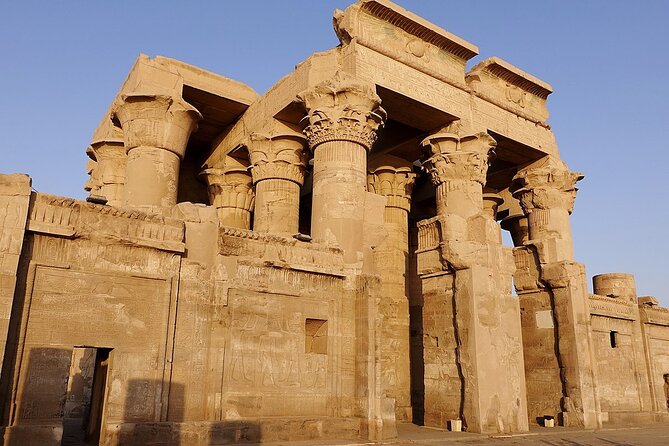
Later, the cruise route reaches Kom Ombo Temple, with about two hours for the visit. Kom Ombo has an unusual double design. It was dedicated to Sobek, the crocodile god, and Horus, the falcon god, so many parts of the temple are arranged in paired form.
The temple was begun under Ptolemy VI and decorated into the Roman period. That mix of Egyptian, Ptolemaic, and Roman work gives your guide plenty to explain, especially if you want to understand how temple building continued after the pharaonic period.
Kom Ombo has recently undergone restoration. I would pay attention to the carved reliefs and the overall layout, rather than expecting a fully intact building. Its appeal comes from the unusual two-god plan and its position beside the Nile.
Day three: Edfu and Luxor after dark
The Temple of Horus at Edfu is one of the best-preserved temples in Egypt. Built between 237 and 57 BC during the Ptolemaic period, it gives you a clear sense of how a large temple was planned, decorated, and used.
The walls contain inscriptions about construction, religious stories, and temple practice. A good guide can turn those carved surfaces into a readable account of the site instead of leaving you to see only columns and stone.
The schedule allows two hours. That is a useful amount of time for a guided visit, though the heat and the scale of the temple may make you glad to return to the air-conditioned transport afterward.
A horse-and-carriage ride is included as part of the tour services. This is a practical detail at Edfu, where the transfer forms part of the visit, but you should confirm the exact arrangement with your guide on the day.
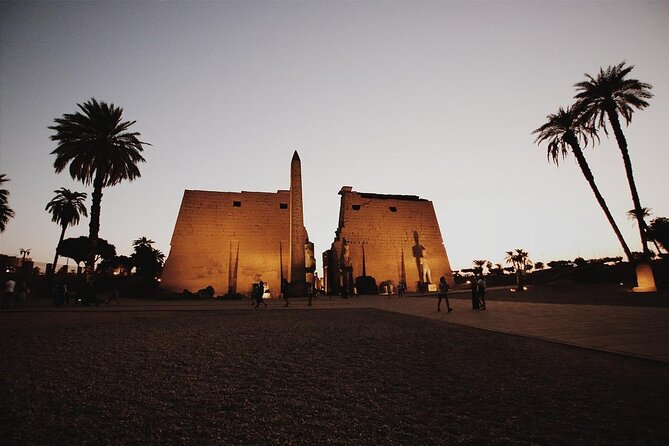
The route then reaches Luxor Temple, on the Nile’s east bank. Founded around 1400 BC, the temple was connected with Amun-Ra, Mut, and Khonsu, the Theban religious triad.
Amenhotep III began major work here, and Ramses II later added important elements, including the courtyard, pylon, and obelisks. The mix of additions makes Luxor Temple feel like a long-running project rather than a single ruler’s monument.
The planned visit lasts about 90 minutes. That is enough for the major areas, but it will feel brief if you want to study every relief. Ask your guide to explain how Luxor Temple related to Karnak and the religious ceremonies of ancient Thebes.
Same sky, a different way to spend the morning:
- From Aswan: 3-Day Cruise to Luxor with Hot Air Balloon
★ 4.3 · 598 reviews - 4-Days Nile Cruise From Aswan To Luxor including Abu Simbel and Hot Air Balloon
★ 4.5 · 509 reviews - 4 Days Nile Cruise from Aswan to Luxor including Abu Simbel and Hot Air Balloon
★ 4.5 · 356 reviews - 4-Day 3-Night Nile Cruise from Aswan to Luxor With Balloon and Abu Simbel
★ 5.0 · 327 reviews
Day four: royal tombs and a sunrise over the West Bank
The final sightseeing day begins on Luxor’s West Bank, where the Valley of the Kings occupies a dry valley opposite the old city of Thebes. Pharaohs and nobles used this area for tombs during roughly five centuries, from the 16th through the 11th century BC.
The program allows about 90 minutes. Entrance fees are separate, and the exact tombs available can vary, so ask which tombs are included in your admission arrangement. The valley is not one single tomb but a group of burial sites spread through two valleys, with most of the royal tombs in the Eastern Valley.
You may find that the wall paintings matter more than the outside appearance. The tombs were built underground, and their decorated passages were designed for the afterlife rather than public display.
Next comes the Temple of Hatshepsut at Deir el-Bahari, scheduled for about an hour. Its three broad terraces climb against the cliffs, giving it a different shape from the more enclosed temples on the riverbank.
Hatshepsut ruled during the 18th Dynasty, and her mortuary temple is one of the most recognizable structures on the West Bank. I like this stop because the architecture works with the setting. The terraces, limestone, and cliffs form one clear composition.
The Colossi of Memnon require only about 30 minutes and are free according to the tour details. These two seated statues once guarded the entrance to the mortuary temple of Amenhotep III. The temple itself is gone, leaving the huge figures as the main survivors.
This is a short stop, but it breaks up the morning and gives you a chance to look closely at the carved figures. Do not expect a long guided visit here.
The final major temple stop is Karnak, with two hours planned. Karnak is a vast complex of temples, columns, courts, and religious buildings built and expanded from the Middle Kingdom through the Roman period.
It was dedicated to the Theban religious triad of Amun, Mut, and Khonsu. The sheer size can make the visit feel scattered without guidance, so this is one place where the Egyptology guide adds real value. Follow the route carefully and ask which parts best show the work of different rulers.
The day also includes a one-hour hot-air balloon flight over Luxor. The flight is described as a sunrise experience, giving you an early view across the West Bank, including the Valley of the Kings and temple sites.
This is the trip’s most unusual feature. You see the monuments from above rather than only walking through them, and the balloon gives you a clearer sense of how the tombs and temples sit across the West Bank.
The balloon operation requires early timing, so expect a demanding day when combined with the archaeological visits. That is a fair trade for a view most standard Nile itineraries do not include.
Guides can make or break the ancient sites
The strongest personal service comes from the guides. Mohamed is praised for answering questions carefully and taking time with small details. He also helped introduce one group to a mosque, adding a local cultural stop beyond the main archaeological program.
Laila is noted for friendly service and clear English. That matters here because the temples are packed with names, dynasties, gods, building phases, and competing interpretations. You will get more from the sites when explanations are easy to follow.
The tour is private for your group, so ask for Mohamed or Laila if either guide is available. The supplied information does not promise a particular guide, but knowing these names gives you a useful request to make when booking.
Comfort, meals, and the pace onboard
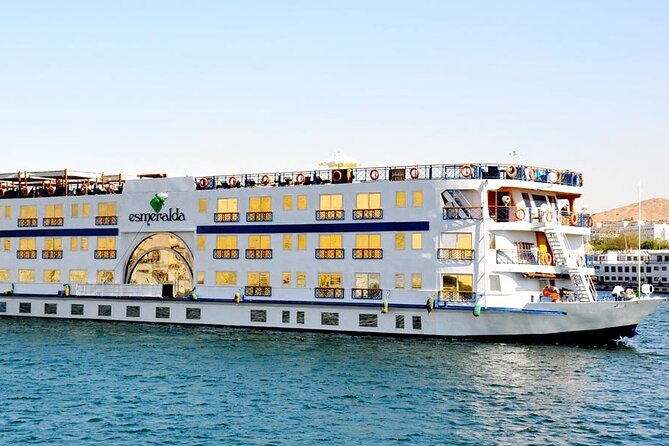
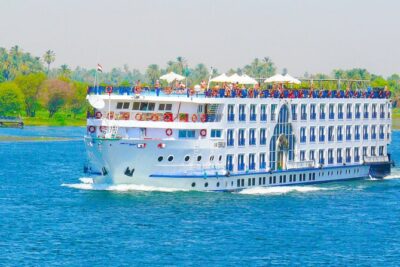
The cruise includes a cabin with full facilities and 5-star accommodation. The exact ship name and cabin size are not given, so I would ask for those details if the quality of the vessel is central to your decision.
Air-conditioned minibus transport is provided for the land visits. That is especially useful for Abu Simbel and the West Bank, where the road portions and warm conditions can make a private, cooled vehicle much more comfortable.
Meals are included from lunch on the first day through breakfast on the last day. The stated total is four lunches, three dinners, and three breakfasts. Dinner entertainment is also included, giving the evenings some activity after the day’s temple visits.
Wi-Fi is included up to 4 GB. That is enough for basic messages and occasional updates, but it is not unlimited service. Save heavy video use for another connection if you want the allowance to last across four days.
The schedule is full. You will see a great deal, but you will not have long, unplanned stretches at each site. That is ideal if your priority is coverage. It is less suitable if you prefer slow photography, long café breaks, or repeated visits to one monument.
Who should book this Nile cruise?
I would choose this trip if you want the main Aswan to Luxor route handled in one package and you value private guiding. It suits first-time visitors who want Philae, Abu Simbel, Kom Ombo, Edfu, Luxor, Karnak, the Valley of the Kings, and Hatshepsut without arranging each leg separately.
It is also a strong match if the balloon flight is a priority. Many Nile cruises include the temples, but the sunrise flight adds a fresh angle and gives you a memorable final morning.
I would hesitate if you need a slow pace, dislike early starts, or want a firm all-in price. The Abu Simbel day is long, and the entrance fees can add noticeably to the $660 cost.
Cancellation is flexible up to 24 hours before the start time for a full refund. Changes or cancellations inside 24 hours are not refunded, and the cut-off uses local time.
Final verdict: a strong route with costs to check
This is a well-packed Upper Nile trip with a sensible route, strong guide potential, and two major extras: Abu Simbel and the balloon flight. I like that transport, meals, boat service, and private touring reduce the usual planning work.
Book it if you want a concentrated look at Upper Egypt and are comfortable paying entrance fees separately. Before confirming, ask for the full admission total, the cruise ship name, cabin details, and whether Mohamed or Laila can guide your group. If those answers suit your budget, the combination of river travel, major temples, royal tombs, and a sunrise flight makes this a worthwhile four-day choice.
FAQ
How long is the cruise?
The trip lasts approximately four days and includes three nights aboard the Nile cruise.
Where does the cruise begin and end?
It begins in Aswan and ends in Luxor. Pickup is available from an Aswan hotel, Aswan Airport, or Aswan Train Station.
Is the cruise private?
Yes. The tour is described as a private activity for your group only.
Is Abu Simbel included?
Yes. Abu Simbel is included in the itinerary, with about seven hours scheduled for the temple complex and related travel.
Are entrance fees included?
No. Entrance fees are listed separately from the included services, so you should budget for them in addition to the $660 price.
What meals are provided?
The package includes four lunches, three dinners, and three breakfasts. Meals begin with lunch on the first day and finish with breakfast on the final day.
Is the hot-air balloon flight included?
Yes. The one-hour hot-air balloon trip over Luxor is included and is described as a sunrise flight.
Which major temples are visited?
The route includes Philae, Kom Ombo, Edfu, Luxor Temple, Karnak, the Temple of Hatshepsut, and Abu Simbel.
Is transportation provided during the tour?
Yes. Pickup and drop-off use an air-conditioned minibus, and a motor boat is included for the Philae visit. Horse and carriage service is also included.
Is Wi-Fi available on the cruise?
Yes. Wi-Fi is included up to 4 GB.
Can I cancel for a full refund?
Yes, if you cancel at least 24 hours before the experience start time. Cancellations within 24 hours are not refunded.
Just added around Aswan
- (3-Nights Cruise From Aswan To Luxor & Balloon, Abu Simbel)★ 4.5 · 23 reviews
- 4-Days Nile Cruise From Aswan To Luxor Abu Simbel and Air Balloon★ 4.5 · 2 reviews
- 3-Nights Cruise From Aswan To Luxor, Hot Air Balloon,Abu Simbel★ 4.5 · 46 reviews
- 4 Days Nile Cruise &Hot Air Balloon on M/S Movenpick Royal Lilly★ 5.0 · 4 reviews
- 8 Nights Egypt Tour,Cairo,Luxor,Aswan&Abu Simbel,Nile Cruise,Hot Air Balloon★ 4.5 · 11 reviews
- Luxor: 4-Night Nile cruise , Hot Air balloon , west bank , abu simbel★ 5.0 · 3 reviews
- (Wonderful 3-Nights Nile Cruise from Aswan to Luxor & Balloon)★ 4.5 · 17 reviews
- 4-Day Nile Cruise: Aswan to Luxor & Abu Simbel + Hot Air Balloon★ 4.5 · 35 reviews
Aswan Hot Air Balloon Rides, compared.
4-Days Nile Cruise From Aswan To Luxor including Abu Simbel and Hot Air Balloon
Read our review →
4-Day 3-Night Nile Cruise from Aswan to Luxor&Abu Simbel+Balloon
Read our review →
4-Day 3-Night Nile Cruise from Aswan to Luxor including Abu Simbel, Air Balloon
Read our review →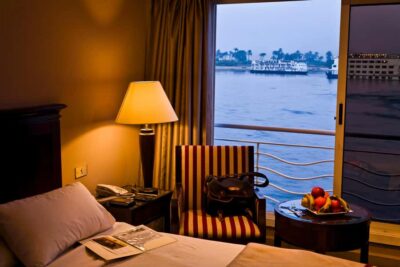
4-Days Nile Cruise From Aswan To Luxor including Abu Simbel and Hot Air Balloon
Read our review →4 Days Nile Cruise from Aswan to Luxor including Abu Simbel and Hot Air Balloon
Read our review →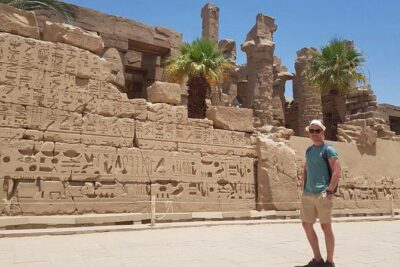
4-Day 3-Night Nile Cruise from Aswan to Luxor With Balloon and Abu Simbel
Read our review →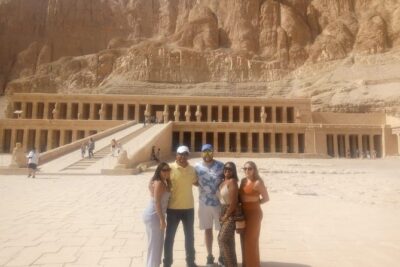
4-Days Nile Cruise Aswan&Luxor,Hot Air Balloon&Abu Simbel.Hot deal
Read our review →Browse the lists this tour appears in